
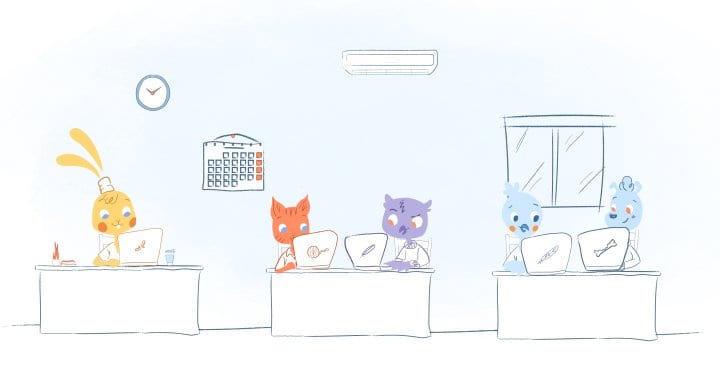
For any business, and startups in particular, productivity is extremely important to being successful in the long run. Unfortunately, a lot of companies unknowingly limit their potential by failing to pay attention to the significance of office design. By understanding the correlation between design and output, you can give your business an advantage.
How Design Impacts Productivity
Up until the late 20th century, the belief was that salary, experience, and innate cognitive abilities were responsible for the efficiency and output of individual employees. And while this is true, a groundbreaking experiment in 1985 revealed that environmental influences are also involved. Specifically, researchers Tom DeMarco and Tim Lister discovered that layout and design of office space directly affect productivity.
In their study, DeMarco and Lister asked 600 software developers across 92 different organizations to fill out surveys prior to competing in a coding competition that measured work performance. The results were astonishing: Those whose surveys reflected positive feelings about their workspaces outperformed the average employee by more than two-fold.
Since this initial experiment, countless other studies have been conducted on the topic and they all seem to reiterate the same thing: The design and décor in a workplace influences the way people think, positively or negatively, and limits or expands their productivity potential.
Originally published on Calendar by Albert Costill.
4 Ways Office Conducive Can Improve Productivity
From a management perspective, these findings are critically important. By optimizing your office and workspace, you can actually get more out of your employees. Practically speaking, here are some specific steps you can take:-
Incorporate Unique Elements
-
Pay Attention to Lighting and Acoustics
-
Enhance Ergonomics
-
Encourage Creativity
Optimize Your Office for Productivity
If you’ve never been made aware of the relationship between office design and productivity, you probably haven’t paid much attention to the different design elements in your employees’ workspaces. But now that you know just how influential design is, you can begin to optimize with output and efficiency in mind. Take things one step at a time and enjoy the fruits of your labor.Originally published on Calendar by Albert Costill.


