
 Given the chance to find out when you might die, would you want to know the answer? Would that have a negative or a positive impact on the way you live your life?
Well, if you are brave enough to face a cold hard number, then take the calculator survey that’s available at Livingto100.com.
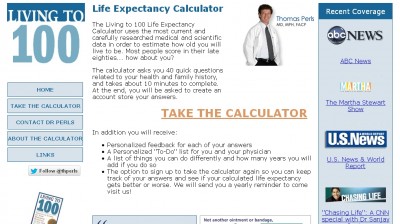
This calculator is the creation of Dr. Thomas Perls, a physician who has used “the most current and carefully researched medical and scientific data” available to date in order to devise it. The survey asks forty questions related to personal health, family history and lifestyle habits and then it calculates one’s life expectancy.
The questions are mostly easy to answer, but the ones that seem most subjective and medically pertinent are the most difficult. For example, most young people do not know anything about their blood pressure or cholesterol and there are a few questions concerning these numbers. Without the bulk of that information, the results seem somewhat less stable.
After the survey that takes about ten minutes, users can see a personalized feedback form which includes suggestions, warnings and medical facts that are meant to steer them down the right path. This information is sent via e-mail – submitting your e-mail address is actually the final step of the survey.
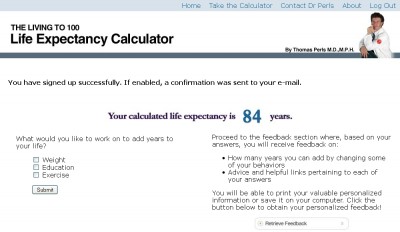
And in addition to getting these warnings and medical facts, you’ll also receive a personalized “To-Do” list and a list of things that can be done differently and the number of years these actions or changes will add to the life expectancy.
Livingto100.com In Their Own Words
“Thomas Perls MD, MPH is the founder and director of the New England Centenarian Study, the largest study of centenarians and their families in the world. More can be learned about the study at www.bumc.bu.edu/centenarian.
The Living to 100 Life Expectancy Calculator is available for licensing and can be tailor-made for your needs as in the settings of human resources departments, health care organizations and other entitites that would like to provide its employees and/or clients with information and links specific to your organization and in some cases interventions (e.g. nurse coaching). Answers to the calculator questions can be provided to the organization as a helpful guage of its employees’ and/or clients’ health-related behaviors, thus allowing for better and more appropriate provision of services to these individuals.”
Why Livingto100.com It Might Be A Killer
This seems like a fun survey but when that number shows up in black and white it sure is scary. Site visitors will most likely have similar reactions to the grave yet simple number. Young people can bet against friends on who will live the longest and those actually interested in the medical side can take active steps to add years to their calculated life expectancy.
Some Questions About Livingto100.com
If users do not know any medical stats such as their blood pressure and cholesterol, how can they figure out as much so that their calculations aren’t affected that negatively?


