
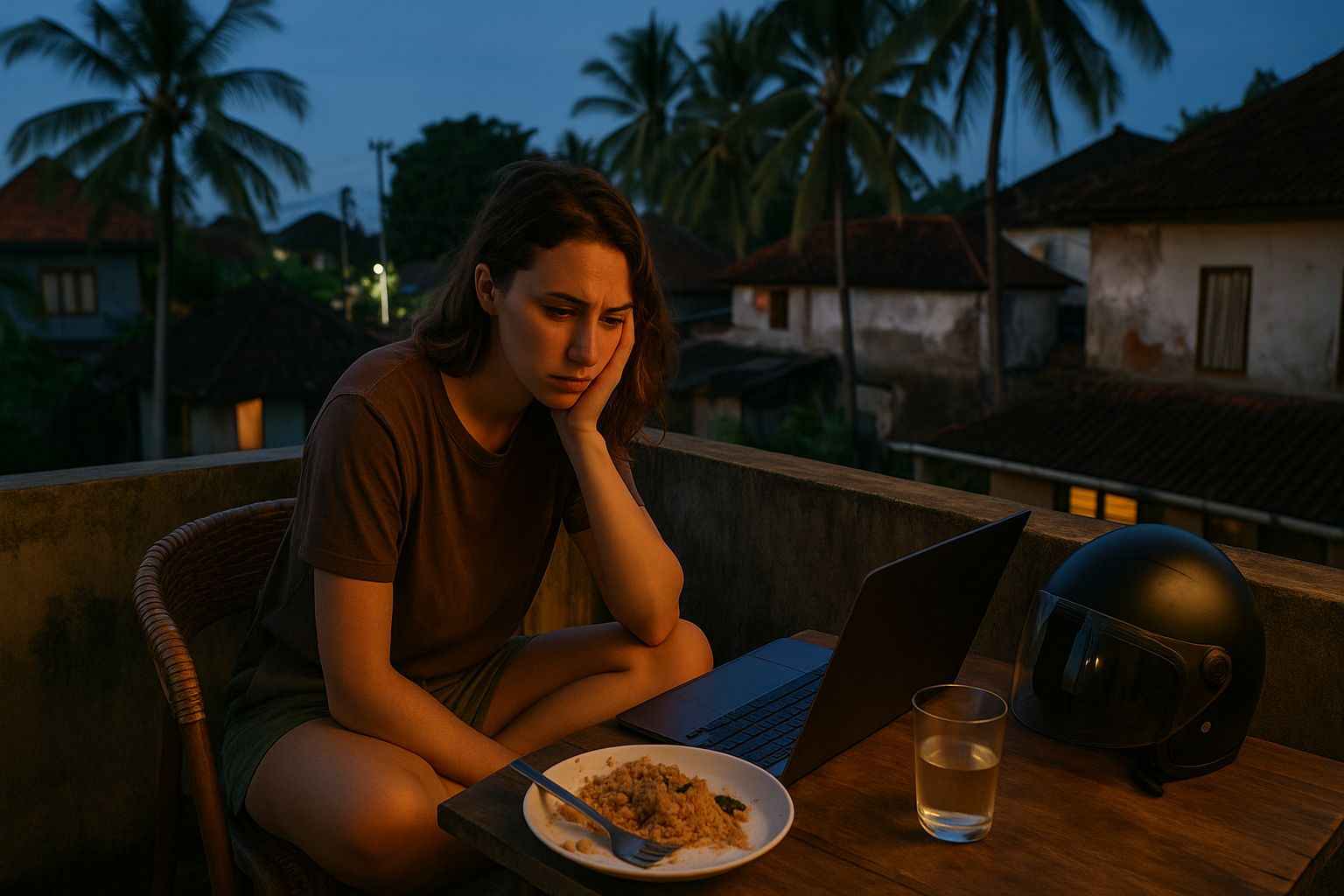
When people imagine living in Bali, they usually picture infinity pools, smoothie bowls, and yoga at sunrise. Social media makes it look like paradise — and in many ways, it is. I get it. I moved to Bali because I wanted that life too. But after spending a full year there living on just $1,000 a month, I discovered a very different side of Bali that no one really talks about.
This is the reality behind those perfect Instagram photos — and it’s not always pretty.
The $1,000/month dream: sounds doable, right?
Before moving to Bali, I read all the blogs and watched all the YouTube videos. They all promised the same thing: “You can live like a king for $1,000 a month!” And in theory, it’s true — kind of.
Here’s how I roughly budgeted my money:
-
Rent (shared villa): $300
-
Scooter rental + fuel: $60
-
Food (mostly warungs): $300
-
Coworking space & Wi-Fi: $100
-
Visa renewals & admin: $70
-
Miscellaneous (laundry, SIM card, toiletries, etc.): $170
It’s tight, but manageable — if nothing goes wrong.
But that’s the thing. In Bali, something always goes wrong.
Let’s talk about healthcare
One of the first things I learned is that getting sick in Bali is not just inconvenient — it can be scary.
Bali Belly is real. Food hygiene is hit or miss, and within my first few weeks, I was violently sick for three days. Then there was the motorbike crash. It wasn’t even my fault — someone cut me off on a tight street. I ended up with a busted knee, a wrecked scooter, and a $250 bill for treatment (and that was considered cheap).
Without travel insurance, that would’ve been a financial disaster. And even with insurance, the quality of care can vary. Some clinics feel like proper hospitals. Others? Not so much.
Instagram vs. reality
Let’s talk about those dreamy photos everyone posts — the lush rice fields, boho cafes, and sunset beach views.
Here’s what they don’t show you:
-
The choking traffic in Canggu
It’s gridlocked by 4 PM. And most of the streets weren’t designed for this much tourism. One pothole and you’re flying. -
The constant noise
Roosters crowing at 4 AM. Motorbikes revving all day. Clubs pumping music till 2 AM — even on weeknights. -
The trash
There are parts of Bali that are pristine. But many beaches — especially after rain — are littered with plastic. Locals do their best, but the waste management system struggles under the weight of mass tourism. -
The stray dogs
Some are sweet. Others are aggressive. I got chased more than once, and friends of mine got bitten. Rabies is a real concern.
The visa hustle
Living in Bali long-term means constantly juggling visas. There’s the 30-day visa-free entry, but if you’re staying longer, you need to get a social visa or a business visa — both of which require paperwork, regular renewals, and sometimes “under-the-table” payments to agents.
You’re in a constant state of semi-legal existence. One slip-up and you’re at the mercy of immigration — which, to be honest, is not a position you want to be in.
Loneliness is real
This one surprised me. Bali is full of people. But making real, lasting connections? That’s harder than it looks.
Yes, there are plenty of digital nomads — but most are passing through. Many friendships feel transactional. Conversations often revolve around crypto, SEO, or someone’s next visa run. It’s fun for a while, but it gets old.
Romantic relationships are also tricky. The dating scene is transient. People come and go. And many are in “vacation mode,” not looking for anything serious.
Local life vs. expat bubble
Most expats live in places like Canggu, Ubud, or Seminyak. These are beautiful — but they’re also pricey and filled with other foreigners. You can easily live in Bali for a year and barely speak a word of Bahasa Indonesia.
The downside? You miss out on the real Bali — the culture, the kindness of local people, the ceremonies, the daily rhythm of island life.
And sometimes, expats cross the line. I saw people treating locals rudely, underpaying staff, or talking about Bali like it’s their personal playground. It made me uncomfortable.
You get what you pay for
Sure, $1,000 a month sounds appealing. But you’re cutting corners everywhere.
-
Your scooter is probably old and sketchy.
-
Your villa might look great online but has mold or no proper plumbing.
-
You’re skipping out on things like gym memberships, travel insurance, or a proper workspace.
There were times when I felt trapped by my budget. I couldn’t afford to fly home. I couldn’t afford to upgrade to a better place. I was living in “paradise” but feeling stuck.
The burnout is sneaky
At first, Bali feels like freedom. No commute. Sunshine. A laid-back lifestyle.
But if you’re freelancing or building a business, the pressure doesn’t go away. In fact, it gets worse.
You’re surrounded by people posting pictures from the beach, but you’re inside hustling to make rent. The FOMO is real. So is the burnout.
And there’s something about always being in a foreign country that keeps you on edge. You’re always “on.” Always navigating a different system. Always slightly disconnected from home.
Would I do it again?
Honestly? Maybe.
Bali taught me a lot. I met some incredible people. I saw jaw-dropping places. I learned to live with less.
But I’d do it differently. I’d budget more — maybe $1,500 to $2,000 a month. I’d stay away from the expat hotspots and try to integrate more with local life. I’d prioritize insurance, proper housing, and mental health.
Living on $1,000 a month can work. But it’s not the dream that Instagram promises.
It’s a hustle. It’s a challenge. And it comes with trade-offs.
So if you’re thinking of doing it — go in with your eyes open. Paradise isn’t perfect. And behind every coconut-on-the-beach photo is a story you don’t always see.


